Is fractional property investing regulated in the UAE? DFSA, VARA and DLD explained
Yes, fractional property investing is regulated in the UAE, but no one body covers every model. Which rules apply depends on how the offer is set up and where the firm holds its licence. In Dubai, any firm that offers property tokens needs a VARA licence.
Key takeaways
- No one UAE body covers fractional property, so how each offer is set up decides the rules.
- In Dubai, VARA is in charge of virtual assets, and that includes property tokens.
- In the DIFC, the DFSA adds extra rules for property crowdfunding.
- A public register entry confirms a licence, but a VARA In-Principle Approval does not let a firm serve clients.
- A licence governs how the firm behaves. It does not stop a property falling in value or guarantee that your share will sell.
Who regulates what: the UAE regulator map
On its public register, VARA says it is in charge of virtual assets in Dubai. In the DIFC, its firms register says, the DFSA is the independent body for financial services. So traditional property crowdfunding in the DIFC sits with the DFSA.
At federal level, the SCA licenses firms that run crowdfunding platforms, a rule in force since 15 June 2022. You can now read its licence rules on the site of the UAE Capital Market Authority. Outside the financial free zones, the CBUAE licenses crowdfunding based on loans. Its Regulation C 7/2020 took effect on 14 November 2020. So the DFSA and the CBUAE oversee different firms in different places, and the protection each gives is not like for like.
| Regulator | Jurisdiction | What it covers | Example structure |
|---|---|---|---|
| Virtual Assets Regulatory Authority | Dubai | Virtual assets and their service providers | Tokens over a title deed or a company |
| Dubai Financial Services Authority | Dubai International Financial Centre | Financial services, including crowdfunding platforms | Property crowdfunding through a company |
| Financial Services Regulatory Authority | Abu Dhabi Global Market | Financial services, including digital assets; security-like tokens treated as securities | Security tokens |
| Dubai Land Department | Dubai | Title registration; jointly owned property register under Law No. (6) of 2019 | Title-deed tokenisation |
| Securities and Commodities Authority | Federal | Licensing of financial activities, including crowdfunding platform operators | Crowdfunding for company shares |
| Central Bank of the UAE | Federal, outside the financial free zones | Loan-based crowdfunding | Project lending through a platform |
Crowdfunding vs tokenisation: why the structure decides the regulator
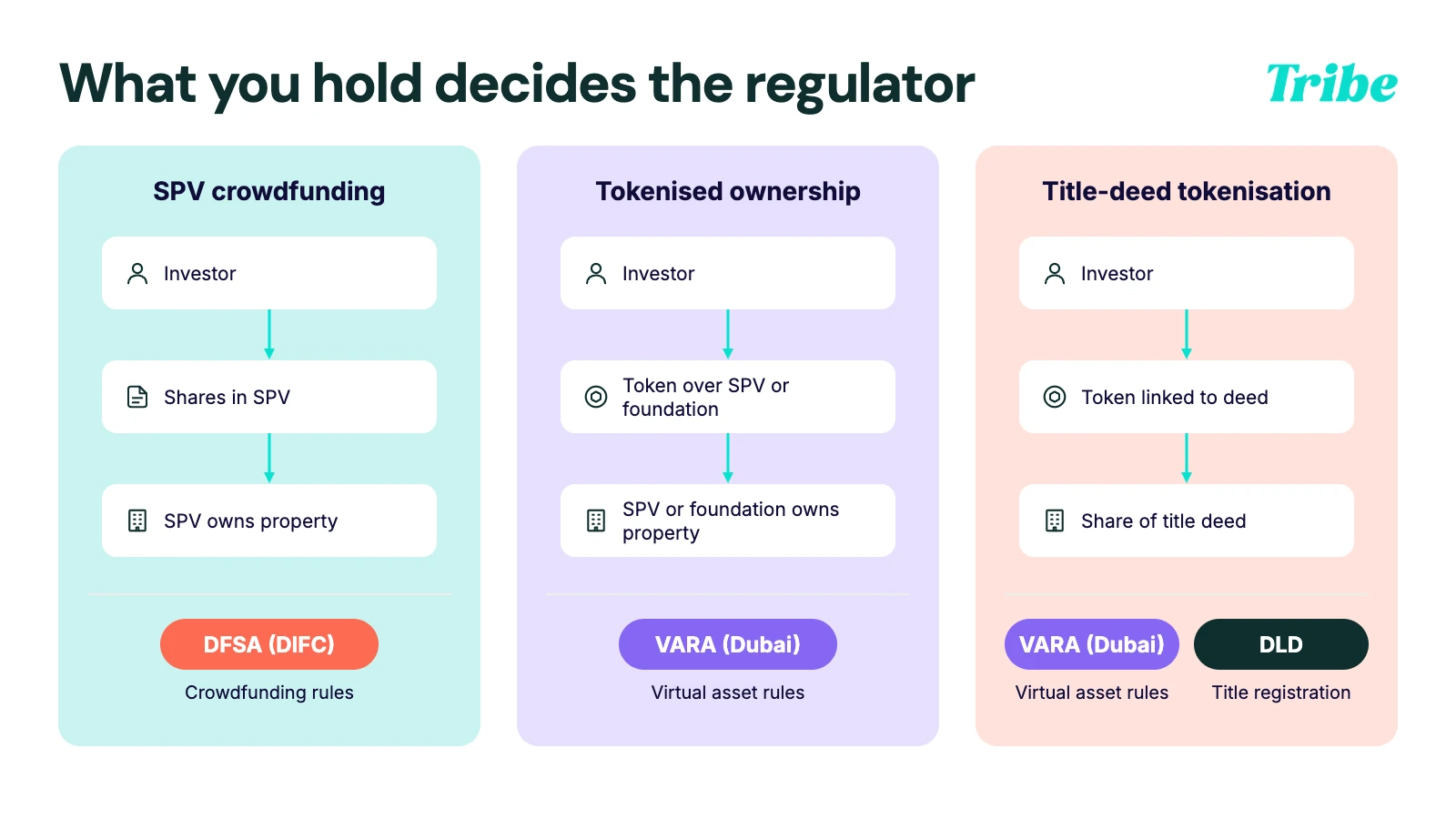
The regulator follows the legal right you get. If you hold shares in a company, crowdfunding rules tend to apply; if you hold a token of ownership, the rules for virtual assets do. When DLD began its pilot in March 2025, it called tokenisation a separate model from crowdfunding, and a more structured one. Crowdfunding, it said, gives small-ticket access through digital platforms.
SPV crowdfunding
An SPV, or special purpose vehicle, is a company set up to own a property. Investors hold its shares, not a part of the deed. A Cabinet Resolution from 2022, No. 36, sets out what counts as crowdfunding, the UAE's official website says. It means raising money online in return for shares in a company. The page was updated on 9 June 2026. In the DIFC, the DFSA sets extra rules for property crowdfunding in its Conduct of Business module (VER51/07-26). Its rule headings cover the SPV and say the property is not to be jointly owned or partly sold.
Tokenised ownership
An ownership token is a digital unit on a blockchain. It can stand for a share of the title deed itself, or for rights in an SPV or a foundation that owns the property. In Dubai, VARA oversees these tokens. DLD runs its token project with VARA and the Dubai Future Foundation through SandBox Real Estate. Its token service page was updated on 3 November 2026. It still calls the project a pilot and asks people to sign up to show interest until the platform goes live. Read how property tokenisation works in Dubai for the steps.
Title-deed tokenisation
DLD says the pilot made it the first property registry in the Middle East to use tokenisation on title deeds. On 29 May 2025, after the first token project sold, it unveiled a Property Token Ownership Certificate. In this route, the investor's share links to the deed itself rather than to company shares.
Which fractional property platforms are VARA licensed?
The best place to check is VARA's public register, which lists each licensed firm and what it is licensed to do. On 10 November 2026, the VARA register listed Tribe Tokenisation FZE as Active, with licence VL/26/06/002. That licence covers Broker-Dealer Services and was issued on 22 June 2026.
We do not list other firms' licences here, so check each one on the day you invest. Use the VARA register, or the DFSA register for crowdfunding in the DIFC. To see how crowdfunding models differ, compare UAE crowdfunding platforms. For the wider picture, read our complete guide to fractional property investment.
How to verify a platform's licence
Match the firm behind the app to an active entry on the right register.
- Find the legal entity: brand names often differ from company names, so check the terms. Tribe, for example, is licensed as Tribe Tokenisation FZE.
- Search the right list: VARA's public register for virtual asset firms in Dubai, or the DFSA firms register for the DIFC. You can filter the DFSA list by "Operating a Crowdfunding Platform".
- Match the details: the licence reference and the entity name should match the register exactly.
- Check what it may do: VARA's register entries say to read the full list of what each firm is licensed to do.
- Check the status: VARA says a firm that only has an In-Principle Approval may not run its business or serve clients until it holds a full licence.
- Check whose licence it is: it should belong to the firm named in your contract, not only to a group company or a "partner".
What are you buying? A due-diligence checklist
You are buying a legal right, not a building. Before investing, confirm what that right is and who controls the asset and the cash.
- Legal right: shares in an SPV, a token over an SPV, or a share of a title deed.
- Title: whether the SPV holds the deed or investors are recorded through DLD.
- Custody: who holds the tokens and their keys, and whether client money sits in a separate account.
- Fees: the full list of charges to buy and hold, plus any charge on exit.
- Reporting: are returns shown after fees? Are they marked as projected or realised, and over what period?
- Exit: how you sell your share, and who decides when the whole property is sold. Under Dubai Law 6 of 2019, a co-owner of a Unit has first right to buy (pre-emption) another co-owner's share. Ask if anything like this applies to you.
- Voting: the rights your holding carries and the threshold for a decision.
- Platform failure: what you own, and how you prove it, if the operator stops trading.
- Documents: the terms and offer papers, read with the register entry.
Is fractional property investment safe? The risks regulation doesn't remove
No fractional property investment is free of risk. The rules govern how firms behave, but they do not hold up property prices or promise you a sale, so your capital is at risk.
- Market value: prices can fall, so you may get back less than you invest.
- Rental voids: income stops when a unit is empty or rent goes unpaid.
- Liquidity: a secondary market needs a buyer, so a sale may take time or may not happen.
- Operator risk: errors or failure at the platform can delay income or access.
- Technology: tokens can be exposed to software faults or hacks.
- Concentration: one property ties your outcome to one building.
- Fees: charges reduce your net return, so ask for the full list.
Virtual assets can lose some or all of their value, and investors have no financial protection scheme to fall back on.
How Tribe is regulated (worked example)
Tribe Tokenisation FZE holds VARA licence VL/26/06/002. Its VARA register entry showed it as Active on 10 November 2026. The licence lets Tribe take on retail investors too, not only institutional or qualified ones. More on Tribe's VARA licence is in our newsroom.
Tribe uses title-deed tokens through DLD or tokens over an SPV or a foundation, depending on the asset and the investor. All of its token work falls under VARA. Its ownership tokens are issued on the XRP Ledger and held on Ripple's custody platform. Tribe holds the keys, but the holdings belong to investors. Investor cash sits in a separate client money account with Zand Bank.
If Tribe failed, title-deed investors would own their share of the deed. For SPV tokens, the terms set out each investor's ownership rights in the SPV. Exit decisions on a property need a token-holder vote. Tribe's secondary market is open 24/7, but each sale needs a buyer, so Tribe can help you sell but cannot promise a sale. See how Tribe works, or browse the Tribe Insights library.
Frequently asked questions
Is fractional property investing legal in the UAE?
Yes, it is legal when the firm offering it holds the right licence. The licence it needs depends on how the deal is set up. VARA covers token offers in Dubai, and the DFSA covers crowdfunding in the DIFC. Treat this as a general guide, not as legal or financial advice.
Is crowdfunding legal in Dubai?
Yes, crowdfunding is legal in Dubai as long as a licensed firm runs it. The UAE government portal says the UAE Cabinet approved it in 2022. The rules for its platforms sit in Cabinet Resolution 36 of 2022. In the DIFC, the DFSA register shows which firms may run a crowdfunding platform.
Is fractional property investment safe?
Fractional property investment carries real risk, and a licence does not remove it. Property values can fall and rent can stop when a unit is empty. You may also struggle to find a buyer for your share. Fees reduce what you keep. Capital is at risk, and you could lose some or all of your money.
Does VARA regulate real estate tokens?
Yes. In Dubai, property tokens fall under VARA, the body for virtual assets. DLD runs its property token project with VARA, as announced on 19 March 2025. The VARA register shows what each firm may do, so check that the token activity offered to you is listed.
How do I check if a platform is licensed by VARA or the DFSA?
Find the firm's legal name in the platform's terms, then search the VARA public register or the DFSA firms register. Make sure the name and licence reference match. Then confirm the status is active and the listed activities cover the offer. A firm with only a VARA In-Principle Approval may not serve clients.
How hard is it to sell a fractional property share?
Selling depends on demand from other investors. Even where a platform runs a secondary market, a sale needs a buyer and is not guaranteed. You may have to wait or accept a lower price. The sale of the whole property follows each offer's own rules, and at Tribe it needs a token-holder vote.
Can non-Emiratis invest in fractional property in Dubai?
DLD's token page says the project opens Dubai's market to buyers at home and abroad. The page was updated on 3 November 2026. Whether you can join a given offer depends on the platform's licence conditions and terms. Tribe accepts UAE residents and overseas investors, though the set-up differs by where you live.
Sources
- VARA: Public Register (accessed 10 November 2026)
- VARA: Public Register entry, Tribe Tokenisation FZE (accessed 10 November 2026)
- DFSA: Public Register, Firms (accessed 10 November 2026)
- DFSA Rulebook: COB 11.6 Property Investment Crowdfunding, extra requirements (VER51/07-26, accessed 10 November 2026)
- ADGM: Digital Assets (accessed 10 November 2026)
- Dubai Land Department: Real Estate Tokenization (updated 3 November 2026, accessed 10 November 2026)
- Dubai Land Department: Launches Pilot Phase of the Real Estate Tokenisation Project (19 March 2025, accessed 10 November 2026)
- Dubai Land Department: Unveils First-of-Its-Kind Property Token Ownership Certificate (29 May 2025, accessed 10 November 2026)
- Dubai Legislation Portal: Law No. (6) of 2019 Concerning Ownership of Jointly Owned Real Property in the Emirate of Dubai (2019, accessed 10 November 2026)
- UAE Capital Market Authority (SCA Rulebook): Licensing of the Financial Activities and Jobs Approval (accessed 10 November 2026)
- Central Bank of the UAE: Loan-Based Crowdfunding Activities Regulation (effective 14 November 2020, accessed 10 November 2026)
- UAE Government Portal: Crowdfunding (updated 9 June 2026, accessed 10 November 2026)